What we're up to
APRIL – Visit to the studios of Timothy Nero and David Olivant – Glorieta and Santa Fe
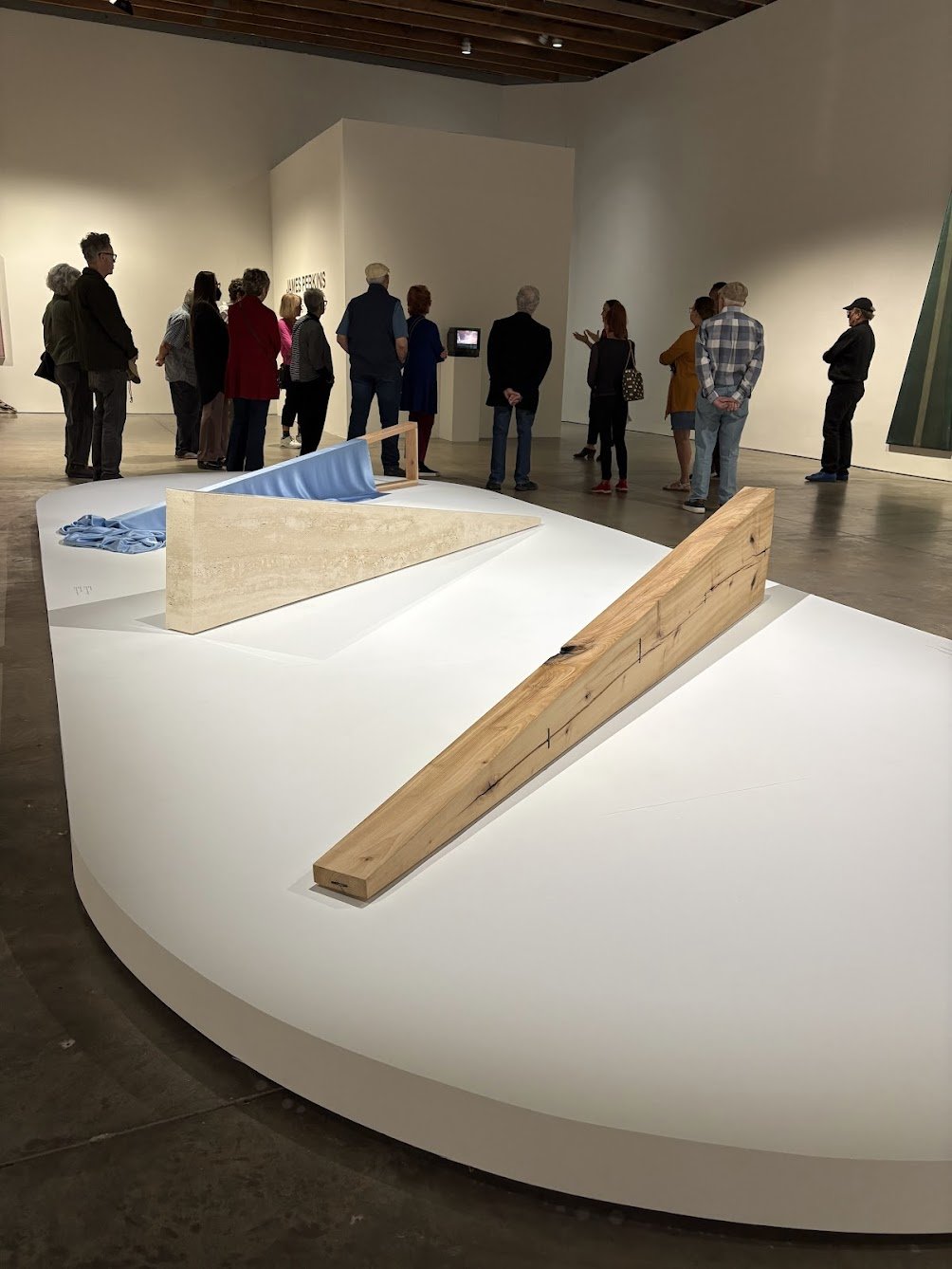
Visit to Timothy Nero Studio
Timothy Nero is a multi-disciplinary visual artist. He is currently painting in acrylic on canvas as well as making sculpture using wood, steel, marine vinyl, fabric and paint. The ideas that drive his work for more than two decades relate to the mind, conditioning, belief systems and stillness.
Nero holds a Master of Fine Arts degree from Florida State University summa cum laude, and a Bachelor of Arts Interior Design/ Architecture from Kent State University.
He has taught drawing and painting at Florida State University, Tallahassee FL, Mount Union College, Alliance OH, The University of New Mexico at Santa Fe and Taos, and Santa Fe Community College.
Nero has exhibited nationally and internationally since 1992 with solo shows at the Phyllis Kind Gallery, Chicago, IL; 5.Gallery, Art Box, Ellsworth Gallery, Santa Fe, NM; Wright Contemporary, Taos, NM, among others.
Recent group exhibitions include Axle Contemporary, The Renga Project: Drawing Exhibition, Santa Fe, NM; Ellsworth Gallery, Group Exhibition, Santa Fe, NM; Axle Contemporary, “The Gesture Rendered”, Santa Fe, NM; 516 ARTS, “Flatlanders and Surface Dwellers”, ABQ, NM; Harwood Museum of Art, “New Mexorado”, Taos, NM; George Billis Gallery, “Rock and Elegance”, Los Angeles, CA; “Strange Weeds”, Bridge Art Fair, Chicago, Il; 2008 Site Santa Fe Biennial, “Lucky Number Seven” as a member of mural team for Scott Lyall, curated by Lance Fung, Santa Fe, NM.
WEBSITE: www.timothynero.com
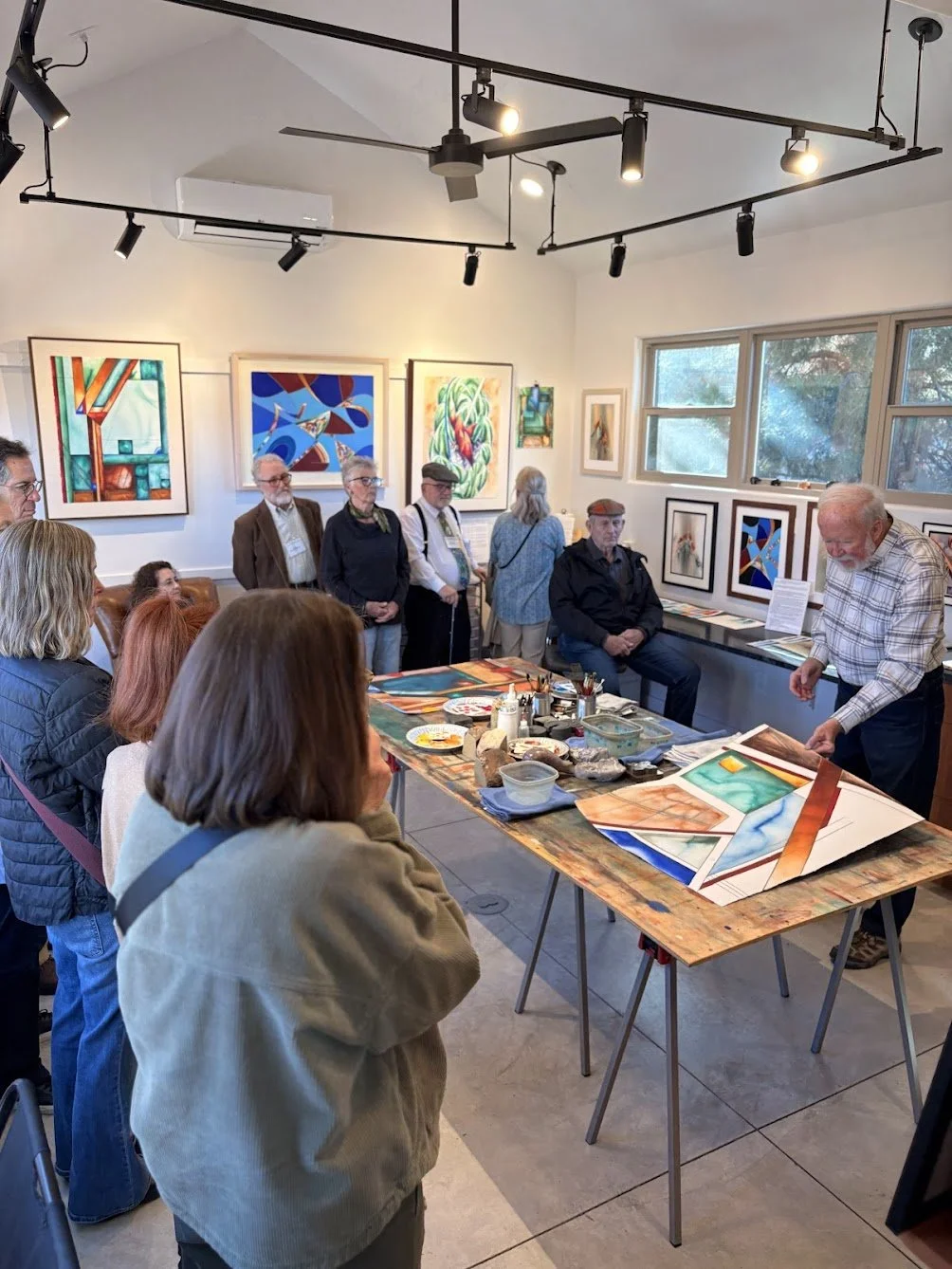
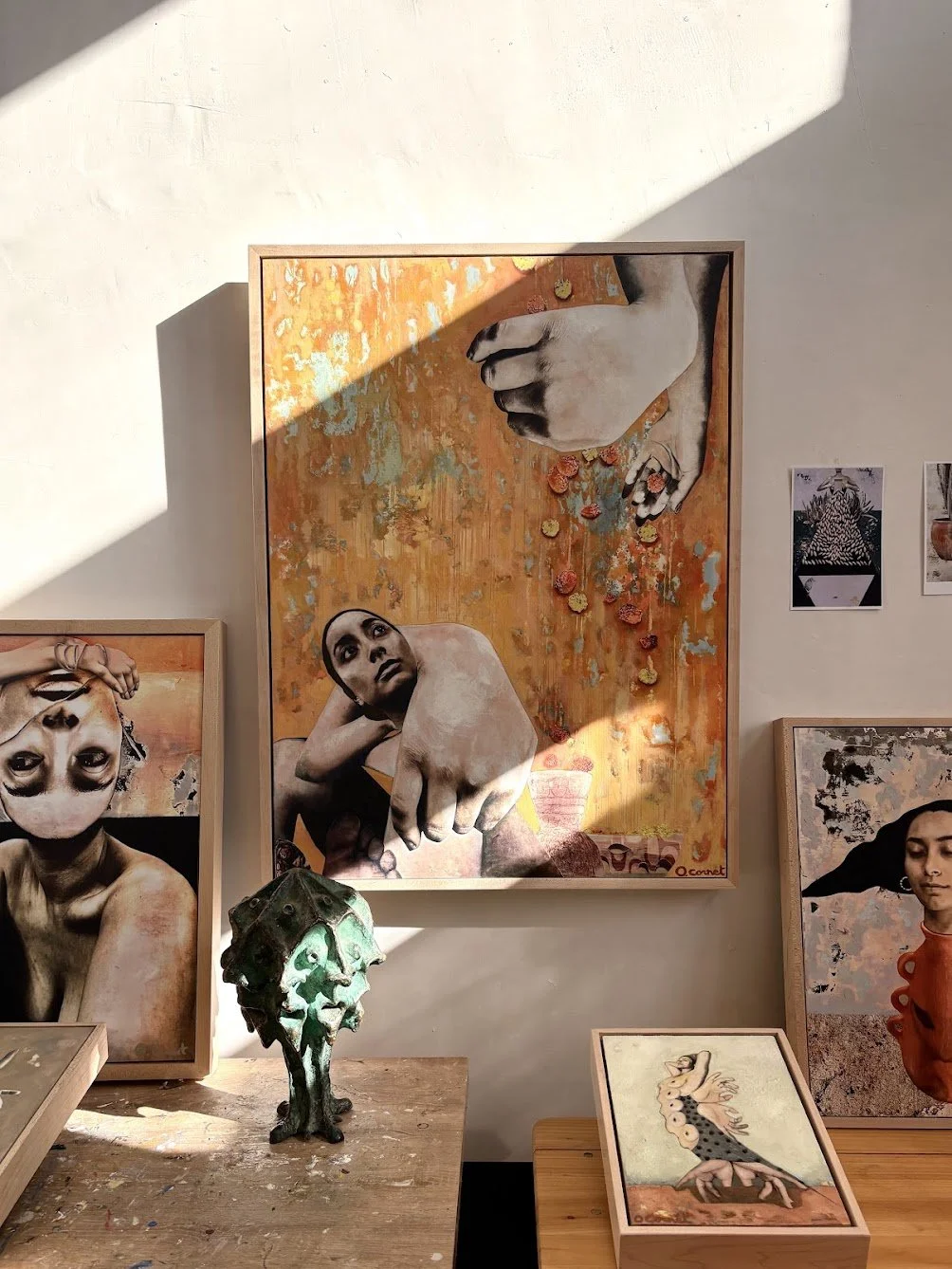
Visit to David Olivant Studio
From David: “The main themes that emerge from my art concern the struggle to make genuine contact with any other locus of consciousness, including our own. My work constantly fuses disparate elements and levels of reality and in doing so seeks to generate unfamiliar emotional states that are created by radical ontological uncertainty. It is this unfamiliarity that I hope provides a shock to the everyday complacency that blunts attempts at contact. Central to the assemblages (Heteroglyphs) and more recent flat works (Retroglyphs) is disruption of viewers’ expectations of just what it is they are actually looking at. This disruption is not a game or intellectual/perceptual conundrum, such as we might find in Op art, some Surrealism or the works of Max Escher. The layers, references and constant hybridization should give the sense of a constant reconfiguring of boundaries, so that we realize we never know on what level we might ultimately take any statement and in so doing relinquish the need for conventional certainties that tend to impede openness. The viewer should be absorbed into the act of generating fresh but constantly sliding meanings or viewpoints rather than encouraged to seek a resolution. It is in this way that images might gain their sense of distinctness, uniqueness, or particularity. The writings of the Russian linguistic theorist, Mikhail Bakhtin and his notions of polyphony and ‘dialogicity’ have been influential for me in this regard.
The ontological uncertainty is compounded by temporal compaction. By this I mean that my Heteroglyphs contain actual and virtual fragments of neglected artworks I produced up to twenty years earlier so that I constantly reference or quote from my own practice. This is inspired by similar sleights of hand in the music of Dmitry Shostakovich, a composer whose use of sarcasm and parody to heighten emotion has greatly influenced the emotional tenor of my own work. This temporal compaction has come to a head in my Retroglyphs which are all performed over large-scale high-res digital photographs of my earlier Heteroglyphs, thus greatly compounding temporal elisions and fractures, messing with autobiography and history and creating an orgy of anachronism! The complex layered process forces an often unsought for reflection on much earlier “outdated” parts of my oeuvre. These are recontextualized in the present moment thus re-configuring my own memories, particularly those that pertain to the making of art.”
WEBSITE: davidolivant.com
———————————————————————————————————————————————————————————-
MAY – Visit to the studios of Emi Ozawa and Jeff Kruger – Albuquerque
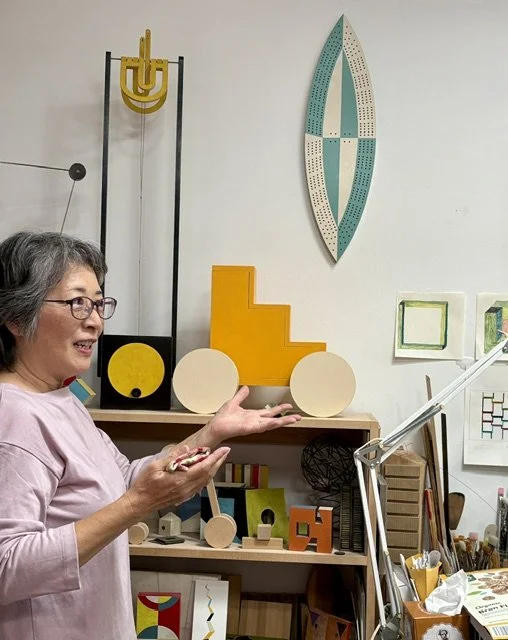
Visit to the studios of Emi Ozawa and Jeff Kruger
From Emi: “Give me a circle & square everyday - I will make a sandwich and eat it for lunch.
The moon in the sky amazes me every time I look up. Full circle to crescent, the magic of geometry has been entertaining in humans for a long long time. It sure has been giving inspirations to my thinking. The circle’s perfection, the energy that is created from equal distancing from the center, the nature of continuity are all fascinating compositional elements. The moon is a three dimensional object, but we only experience it as a two dimensional shape which depends on where it is and how the light is cast. Our perceptions change through the month.
‘Square one’, I was very pleased to learn this expression in English. It is another shape/place where my ideas start. I believe that the roots of this interest and seeing beauty in formal geometry are in part coming from my home country Japan, where the square is used in many cultural forms. The tatami floor mat, for example, a rectangle with proportions of 2:1 is used to define many aspects of domestic architecture. Origami might be the most recognized Japanese use of the square as the ‘origin’ of invented form. Just folding it once, it becomes a triangle or a rectangle. It is a visual amusement park to me.
I am interested in how geometry can distort from various perspectives, a circle to an oval, a square to a rhombus. A curved line can be seen straight. An angle disappears into a straight line. To realize these interests, I take the picture plane and make it a 3D experience, and/or present a 3D object to be viewed as a flat plane.
Please note that side views are equally important as a front view in my creations. There are many points of view when you see.”
From Jeff: “My education and practice as an artist has been distinguished by a diverse application of media and techniques, as a ceramicist, sculptor, designer, painter, graphic artist, and installation artist, all of these serving as a means of both rendering the world before me and re-visioning it. Essentially, I think of myself as an abstract social realist. I make abstractions which are a form of social or cultural study. I also make realist works, which portray the abstractions of being human; faith, emotion, desire, language, and more.”
WEBSITES: Emi Ozawa - emiozawa.com | Jeff Krueger - OtherPeoplesPixels
———————————————————————————————————————————————————————————-
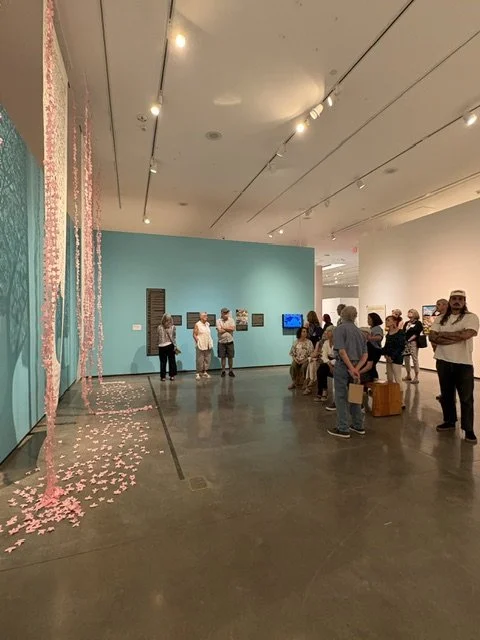
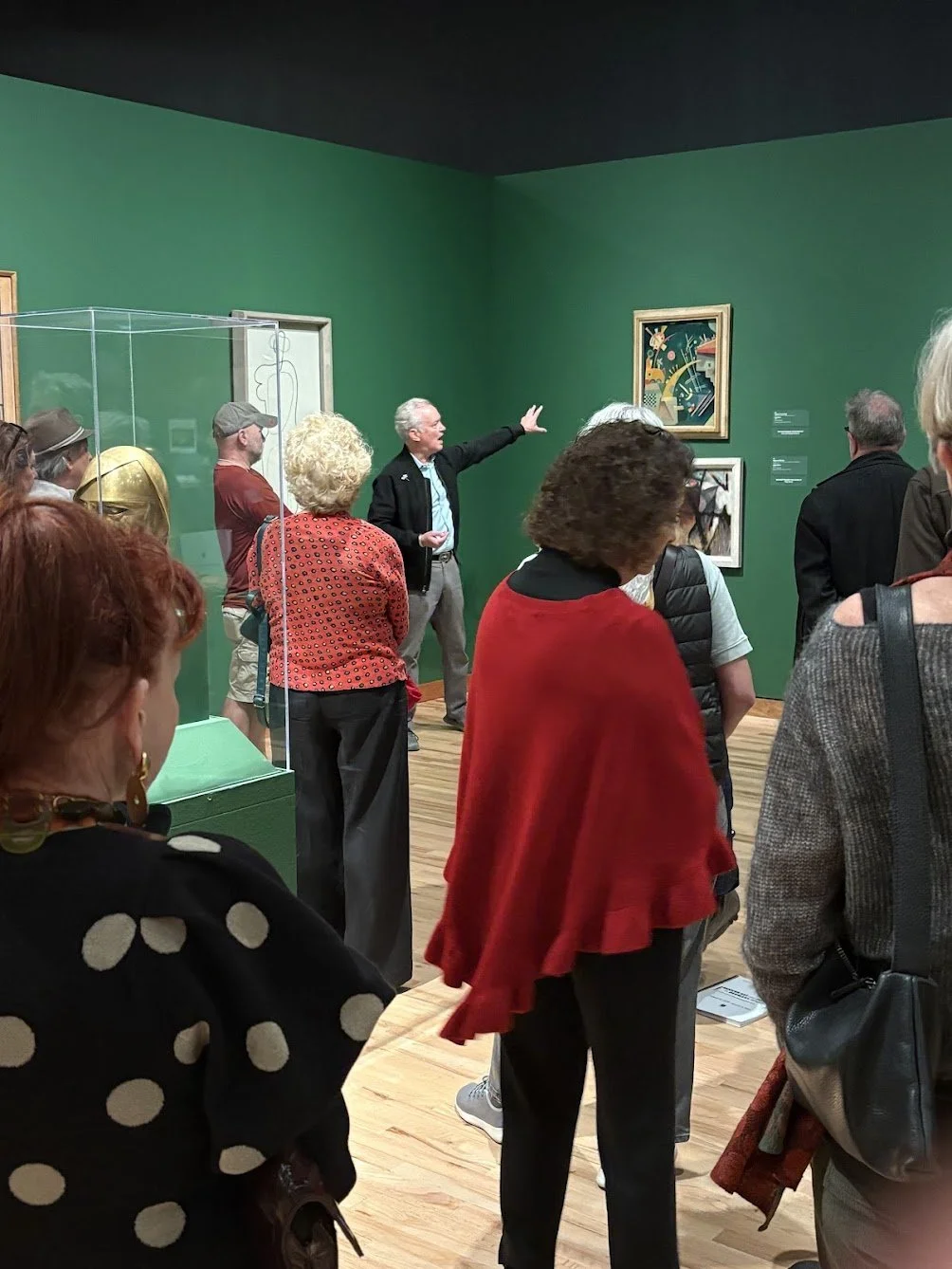
JUNE – Guided tour of Nuclear Past, Present, and Future: Art in Action at NHCC – Albuquerque
Guided tour of Nuclear Past, Present, and Future: Art in Action with Jadira Gurulé
The exhibition examines the impact of nuclear technology on both New Mexico and the world. Head Curator, Jadira Gurulé says, “The project examines the impact of nuclear technologies, its devastating human and environmental toll, and the artistic expression and activism of community members advocating for justice.” Gurulé mentioned that artworks will explore everything from nuclear technology worldwide, to uranium mining and social justice topics related to nuclear issues, such as downwinders seeking medical compensation from radiation sickness caused by the testing of the first atomic bomb.
This exhibition was developed as a collaboration with the Tularosa Basin Downwinder’s Consortium. Mary Martinez-White, a member of TBDC, reached out proposing an iteration of the exhibition, Trinity: Legacies of Nuclear Testing-A People’s Perspective that opened at the Branigan Cultural Center in 2023. This exhibition was the TBDC’s own collection of work dedicated to preserving the stories of real life native New Mexican downwinders along with the stories of New Mexican uranium miners and their families. The NHCC evolved and expanded the project beyond artists just in the original show.
Gurulé explained that as the NHCC was considering the show, they wanted to recognize the significant issues nuclear technology presents to our society and culture. They also found the dialogue created by this work was relevant to the mission of the NHCC, which is to preserve and promote Hispanic art and culture.
Featuring approximately 60 artworks, 32 artists were selected for the exhibit through an application process where Gurulé, Martinez-White,and members of the TBDC on the exhibition committee Joanna Keane Lopez and Alicia Romero, cast a wide net in their networks to invite artists to submit artworks for consideration. Works were then selected according to what the curators felt were strong representations of the exhibition premise. The exhibition is a collection of multimedia artworks from artists in the United States.
Where we've been
“This world is but a canvas to our imagination...”
Image of CAS Visit to the Dwan Light Sanctuary, Las Vegas, NM, October 2022